

Valve's Steam Frame has finally reached customers seven years after the Valve Index set the baseline for PCVR. Announced in late 2025 and delayed repeatedly throughout 2026 by memory shortages and supply bottlenecks, Valve's standalone headset arrives late to a market that moved on. While Valve spent years developing a battery-powered console headset, Pimax took the opposite route with the Pimax Dream Air: a sub-170g chassis built around 8K Sony Micro-OLEDs and direct DisplayPort transmission. On the sim rig, the performance gap between these two approaches is immediately obvious.

Pimax Dream Air
Built exclusively for PC-driven sim racing. Sony 8K Micro-OLEDs, raw DisplayPort 1.4 pipeline, inside-out SLAM, and Tobii eye-tracking.
View Dream Air
Valve Steam Frame
Standalone SteamOS console headset with Snapdragon 8 Gen 3 SoC. Relies on 2160×2160 LCD panels and wireless streaming.
Reservation Queue RequiredThe Production Delay Factor
Valve designed the Steam Frame around an all-in-one mobile architecture. Integrating a Qualcomm processor, heat pipes, internal battery, and wireless antennas stretched out development. By the time shipments started in September 2026, its 2160×2160 LCD panels were already behind current Micro-OLED hardware.
Specifications Comparison
| Specification | Pimax Dream Air | Valve Steam Frame |
|---|---|---|
| Display Technology | Dual Sony Micro-OLED | Dual Fast-Switch LCD |
| Resolution Per Eye | 3840 × 3552 (13.6MP) | 2160 × 2160 (4.66MP) |
| Total Pixels | 27.2 Million | 9.3 Million |
| Contrast Ratio | 100,000:1+ (Pure Black) | 1,200:1 (Backlit Gray) |
| Video Connection | Native DisplayPort 1.4 | Wi-Fi 7 / USB-C Compressed |
| Streaming Latency | < 1 ms (Uncompressed) | 25–40 ms (Encode/Decode) |
| Headset Weight | < 170g (Front Visor) | 440g Visor / 550g Total |
| Eye-Tracking & DFR | 120Hz Tobii (Standard) | 90Hz Custom Streaming |
| Power / Runtime | Continuous (PC Tethered) | 1.5–2.5 Hours (Battery) |
| Base Rig Price | $1,999 USD ($1,959 with code SRN) | $1,199 USD (Headset Only) |
Display Resolution & Night Stints
Sony Micro-OLED panels provide 27.2 million pixels with true blacks. Apex curbing, distant apex cones, and instrument clusters remain crisp at 180+ mph.
Fast-switch LCD panels total 9.3 million pixels. Lower pixel density softens brake markers and track detail at high speed down long straights.
On the track, that difference shows up in braking markers and dash readouts. Coming down the Kemmel Straight at Spa, the 100-meter board is sharp and readable early in the braking zone with the Dream Air. On the Steam Frame, the board remains soft until you are significantly closer.
Panel contrast is just as decisive. The Steam Frame's LCD backlight produces gray blacks. During night stints at Le Mans or Sebring, dark track sections look milky. The Dream Air's Micro-OLED pixels shut off completely, giving true black backgrounds with clean headlight illumination.
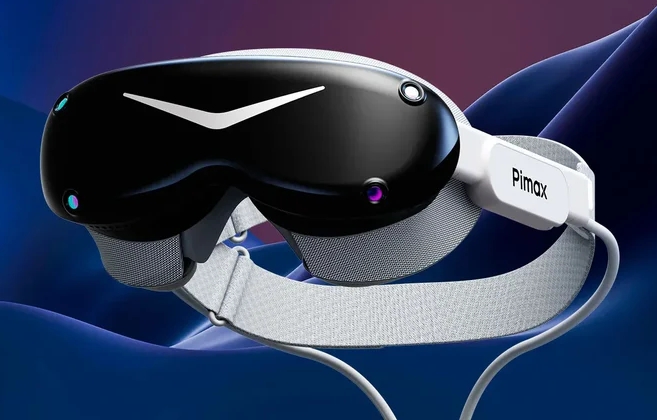
Dream Air Series
Featherweight comfort meets high-resolution optics. Tailored for endurance sim racing stints where neck fatigue is the enemy.
Wireless Latency vs. Direct DisplayPort
Dedicated sim racers require instant visual feedback. When the rear axle steps out over the curbs in Turn 3 at Silverstone, a 30-millisecond latency spike means the car has rotated past the point of recovery before your eyes register the slide.
The Dream Air transmits uncompressed DisplayPort 1.4 data down a slim fiber-optic cable with sub-millisecond latency. You catch counter-steer moments instantly. The Steam Frame relies on wireless video compression or USB encoding, adding frame compression artifacts and motion delay that hurt competitive consistency.
Cockpit Mass & Long-Stint Fatigue
By offloading compute and batteries to your high-end PC, the chassis sits almost weightlessly on your face. You get zero pendulum effect or neck strain through high-G corners and curb hopping.
Carrying an onboard Qualcomm Snapdragon 8 Gen 3 chip, cooling fans, heat pipes, and an internal battery adds substantial mass. Long sessions on a direct-drive rig result in noticeable neck fatigue.
On an aluminum profile rig with high-torque direct-drive wheelbases and 100kg hydraulic pedals, carrying over half a kilogram on your skull creates rapid fatigue during 60-minute endurance stints. The Dream Air's sub-170g profile completely vanishes once your race starts.
Battery Limits vs. Continuous Racing & Tobii DFR
The Steam Frame's internal battery lasts between 1.5 and 2.5 hours. Running practice, qualifying, and a 45-minute race drains the battery to empty, requiring a recharge or an external battery pack wired awkwardly to your rig seat. In contrast, the Dream Air is powered directly over its lightweight tether cable, allowing you to run two-hour sprint blocks or multi-driver endurance events with zero battery management.
Furthermore, the Dream Air includes 120Hz Tobii eye-tracking standard. Through OpenXR on the sim, Dynamic Foveated Rendering tracks your pupil position and focuses full GPU rendering where you look, improving frame rates by 30% to 50% in heavy grids. The Steam Frame's eye tracking is tuned for wireless foveated streaming rather than native PCVR pipeline acceleration, leaving sim racers without the same direct frame-rate gains.
Final Verdict
Valve designed the Steam Frame as an all-around portable SteamOS console, and those mobile concessions severely penalize dedicated sim racers. Its 2160×2160 LCD panels, streaming compression latency, 550g face mass, and 2-hour battery limit hold it back from true competitive PCVR.
- Visual Supremacy: 27.2 million Sony Micro-OLED pixels give 3x the pixel density and pitch-black night racing contrast.
- Zero Latency: Direct DisplayPort 1.4 eliminates the 30ms wireless streaming lag needed to catch oversteer slides instantly.
- Pure Sim Comfort: Sub-170g chassis mass prevents neck strain during multi-hour endurance events.
- Native Tobii DFR: Integrated 120Hz Tobii eye-tracking yields a 30% to 50% frame-rate boost in dense 40-car grids.