

Pimax just officially pulled back the curtain on the Pimax Crystal Pro at their global Frontier launch event. While the sim racing community has spent recent months celebrating the tethered clarity of the Crystal Light, the Crystal Pro takes a bold swing at something racers have wanted for years: true high-resolution PCVR without a cable holding you back.
The Crystal Pro is not just another standalone headset running mobile phone games. It is built from the ground up as a dedicated PCVR machine that beams uncompressed images straight from your computer's graphics card into your headset. Here is a breakdown of what was announced, how the technology works, and what we might see during the upcoming Black Friday shopping season.
Native Foveated Streaming Explained
Every wireless VR headset up to this point has had one big flaw: video compression. When you stream PCVR over regular Wi-Fi or USB cables, your graphics card has to compress the video frame using codecs like AV1 or HEVC. On the track in games like iRacing or Assetto Corsa Competizione, that compression makes distant brake markers, apex curbs, and oncoming traffic look fuzzy and washed out.
Pimax solves this with a system called Native Foveated Streaming. Human eyes only see sharp, high-definition detail in a small circle right where we are looking. The Crystal Pro uses built-in 120Hz Omnivision eye-tracking cameras with ten infrared emitters per eye. The software finds your exact focal point on the screen.
When paired with the new third-generation 60G AirLink kit, the system sends the raw, uncompressed pixels for that center focus area straight from your graphics card over a 60GHz wireless link. The data speed reaches up to 6 Gbps. Because there is no video encoding step for your focal area, what you see is the true native image from your GPU with less than 2 milliseconds of added latency.
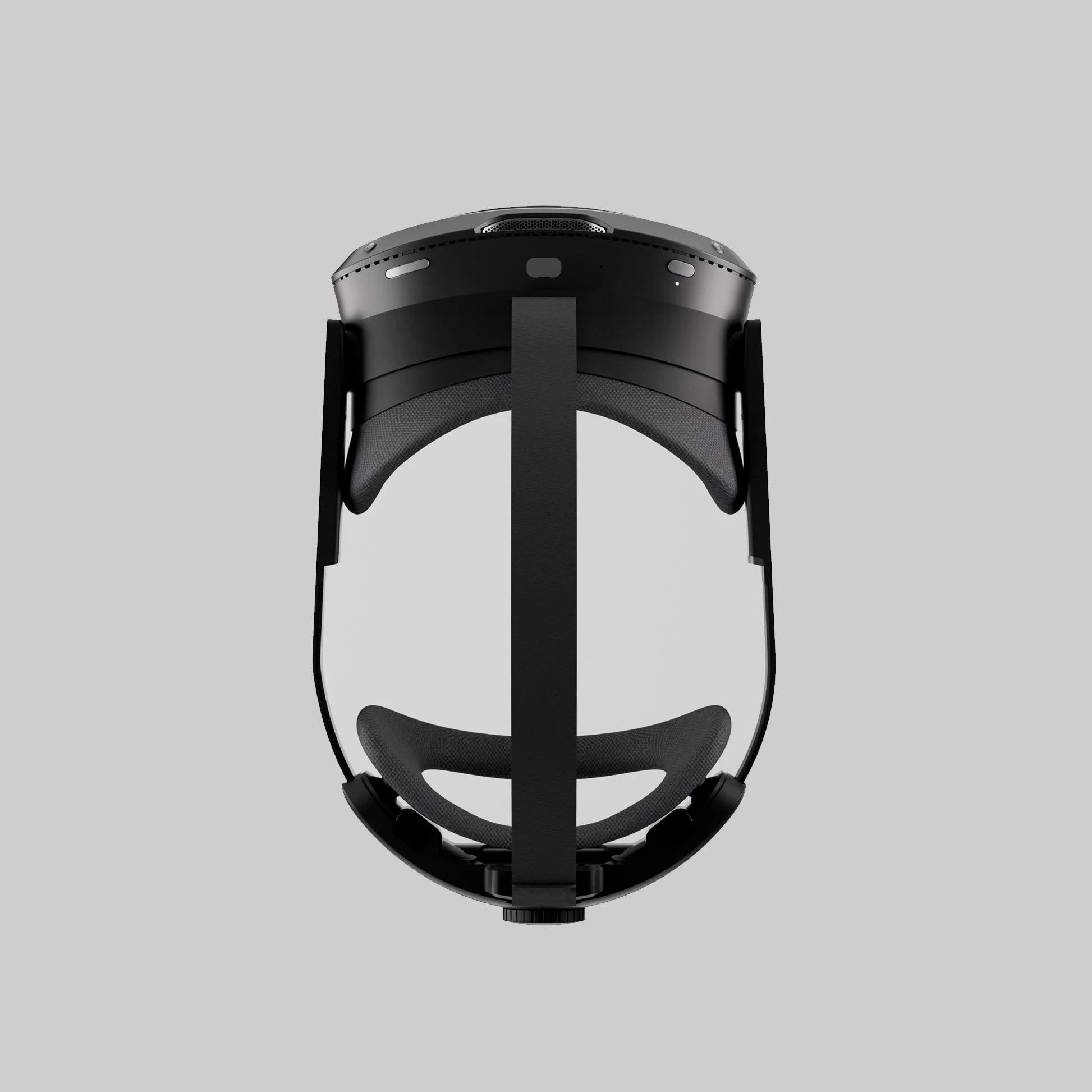 The Crystal Pro features a rigid backstrap, magnetic face foam, active cooling, and new Stratosphere Blue trim.
Display Specs and Optical Clarity
The screen hardware inside the Pimax Crystal Pro matches what high-end sim racers expect from modern glass optics:
- Resolution: 2880×2880 pixels per eye (over 17 million pixels total across both eyes).
- Panels: Quantum-Dot QLED screens with Mini-LED backlighting, packing 576 local dimming zones per eye for deep black levels during night racing.
- Lenses: Replaceable aspheric glass lenses delivering edge-to-edge clarity with 35 pixels per degree (PPD) and a 110-degree horizontal field of view.
- Refresh Rates: Smooth operation across 72Hz, 90Hz, and 120Hz modes.
- Brightness: Rated at 200 nits, keeping cockpits clear and bright under direct sunlight.
Wired DisplayPort Mode for Long Endurance Races
One of the smartest design choices Pimax made is giving drivers flexibility. Wireless freedom is fantastic for room-scale titles or quick sprint sessions, but sitting in a sim rig for a 6-hour or 24-hour team race requires reliable zero-battery operation.
The Crystal Pro includes a direct DisplayPort 1.4a connection option through a single tether cable. When connected with DisplayPort, the headset runs natively at its full 120Hz refresh rate with zero latency, zero wireless interference, and unlimited continuous runtime, exactly like the Crystal Light.
External Battery and Weight Distribution
Heavy batteries on the front of a VR headset ruin long driving stints. They cause neck fatigue, push into your forehead, and wobble when you brake hard. Pimax skipped placing a heavy battery inside the front casing.
Instead, wireless power comes from an external 16,000mAh battery pack that you clip onto your waist or drop into your pocket. This keeps the front of the headset balanced and light, while the rigid rear headstrap distributes clamping force evenly around your skull.
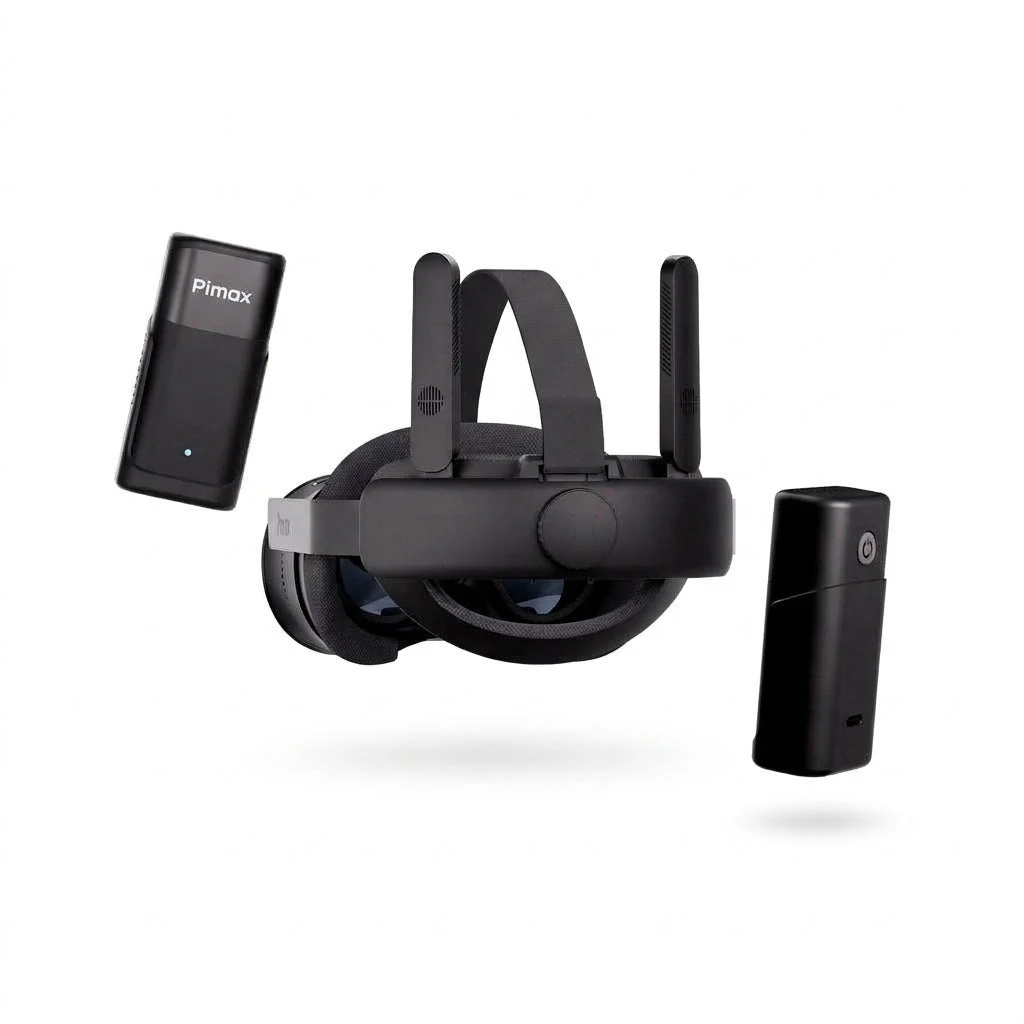 The optional third-generation 60G AirLink kit attaches two compact antennas directly to the Crystal Pro top housing.
Modular Faceplates and Lighthouse Tracking
The front faceplate on the Crystal Pro is completely swappable. By default, the headset uses Pimax SLAM 2.0 inside-out tracking powered by four optical cameras and infrared illumination for low-light rooms.
If you race on an aluminum profile rig with heavy force feedback or motion actuators, inside-out cameras can occasionally get confused by fast vibrations. You can swap in the optional Lighthouse faceplate to track with SteamVR laser base stations. This makes the Crystal Pro the only wireless headset available that supports SteamVR Lighthouse tracking. An optional Mixed Reality faceplate with full-color passthrough and LiDAR depth sensing is also available.
Pimax Crystal Pro Early Reservation
Reserve your Crystal Pro spot for just $1 to get $20 off the headset or $50 off the 60G AirLink bundle. Stack coupon code SRN at checkout for additional savings.
Black Friday 2026 Speculation and Early Pricing
The Pimax Crystal Pro is priced at $1,399 for the standalone headset and $1,899 for the complete bundle with the 60G AirLink kit. Hands-on public demos are scheduled to begin in Q4 2026, with customer shipments rolling out in spring 2027.
Because production lines will be gearing up through the winter, what can we speculate about Black Friday 2026?
- Reservation Incentives: Pimax has already opened a $1 reservation queue. Reserving locks in $20 off the headset or $50 off the wireless bundle. For Black Friday, Pimax may introduce extra accessory incentives, such as discounted faceplates or priority production queue slots.
- Coupon Stacking: Official partner discount code SRN will work on checkout orders, giving sim racers an easy way to trim overall rig costs.
- Bundle Perks: During past holiday sales, Pimax frequently threw in free audio upgrades like the off-ear DMAS earphones. We anticipate pre-order packages during the holiday period may bundle the new DMAS 2.0 at reduced promotional rates.
Frequently Asked Questions
What is Native Foveated Streaming?
It is a new wireless technology from Pimax. It tracks your eyes at 120Hz and sends the center of your view directly from your graphics card over a 60GHz link with zero video compression, so your focus area stays razor sharp.
Can I use the Crystal Pro as a wired headset on my sim rig?
Yes. The headset supports an optional DisplayPort 1.4a cable. Plugged in, you get native 120Hz refresh rates and continuous power with zero reliance on the battery.
Does the Crystal Pro work with SteamVR base stations?
Yes. You can swap on the optional Lighthouse faceplate to use SteamVR 1.0 or 2.0 laser base stations in both wired and wireless modes.
Final Verdict
The Pimax Crystal Pro bridges the gap between ultra-clear sim racing optics and tether-free PCVR. By combining glass lenses, QLED Mini-LED panels, uncompressed 60GHz streaming, and an optional DisplayPort cable, it gives sim racers the freedom of wireless without forcing them to drive through blurry compression artifacts.
- Native Foveated Streaming: Sends raw GPU pixels straight to your eyes with under 2ms added latency.
- Dual-Mode Versatility: Play wireless for standing games or plug in via DisplayPort 1.4a for multi-hour sim endurance races.
- Lighthouse Compatibility: The only wireless PCVR headset on the market that supports SteamVR laser tracking faceplates.
- Comfort Minded: External 16,000mAh battery keeps weight off the front of your face.
- Early Black Friday Savings: Put down a $1 reservation to lock in early discounts and stack coupon code SRN at store.pimax.com.