

Wireless VR has always been a tough sell for sim racers. While casual room-scale players are happy to dance around their living rooms on standard Wi-Fi streams, sim racers sit strapped into high-powered cockpits. We look hundreds of meters down long straightaways trying to spot distance boards at 170 MPH. A fuzzy compressed video stream or twenty milliseconds of wireless lag can ruin an entire qualifying lap.
With the global reveal of the Pimax Crystal Pro, the wireless debate has entered a completely different gear. On one side stands Pimax's dedicated uncompressed 60GHz PCVR setup. On the other stands Valve's long-rumored standalone device, the Valve Steam Frame. Here is how their specifications, wireless pipelines, and on-track driving dynamics compare for serious sim racers.
The Wireless Bottleneck: mmWave vs. Standard Wi-Fi
The single biggest technical difference between these two headsets comes down to how images travel from your PC graphics card to your eyes.
The Valve Steam Frame is designed as a standalone headset powered by an onboard mobile processor. To run PC sim titles like iRacing or Assetto Corsa Competizione, it connects to your PC over home Wi-Fi (Wi-Fi 6E or Wi-Fi 7). Because home Wi-Fi bands cannot move raw display data, your graphics card has to compress each frame using video codecs like AV1 or HEVC. On the track, this compression turns distant tarmac textures and brake markers into smeared pixels, while adding 25 to 45 milliseconds of latency.
The Pimax Crystal Pro bypasses standard Wi-Fi entirely. It pairs with a dedicated 60GHz millimeter-wave wireless module delivering up to 6 Gbps of raw bandwidth. Using 120Hz eye tracking, it aims an uncompressed native GPU stream directly at your focal point. You get the raw clarity of a physical DisplayPort cable with under 2 milliseconds of added wireless latency.
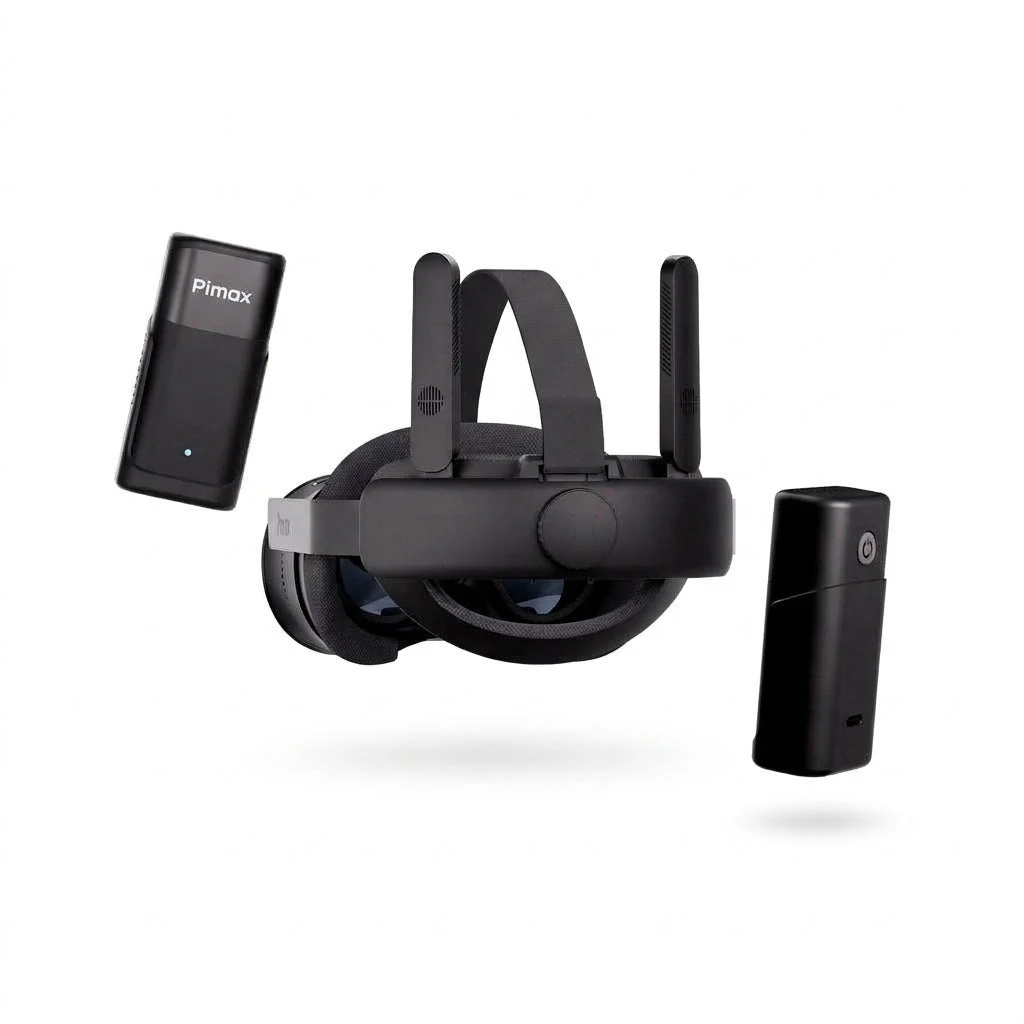 The Crystal Pro uses dual top-mounted 60GHz antennas to receive raw, uncompressed GPU frames with zero codec delay.
Display Clarity and Glass Lenses
In sim racing, clarity is everything. Cockpit dials, digital dash displays, and distant corner apexes demand pixel density and clean optics.
- Pimax Crystal Pro: Packs dual 2880×2880 Quantum-Dot QLED panels with Mini-LED backlighting (576 dimming zones per eye). It features replaceable aspheric glass lenses that yield 35 pixels per degree (PPD) and a wide 110-degree horizontal field of view.
- Valve Steam Frame: Expected to target lower resolutions (around 2160×2160 per eye) using standard plastic pancake optics to manage thermal limits on its internal mobile processor.
Glass lenses deliver noticeably higher light transmission and zero internal glare compared to pancake optics, which lose over 75% of their light through polarizing filters. During night stints at Sebring or Le Mans, the Crystal Pro's local dimming produces true inky blacks without the grey haze typical of basic LCD screens.
Wired DisplayPort Mode for Long Endurance Stints
Sim racing is unique because many drivers participate in team endurance races lasting 6, 12, or 24 hours. A battery running out of juice while leading an endurance race with ten laps remaining is every sim racer's worst nightmare.
This is where the Crystal Pro offers a major practical advantage. It includes a dedicated DisplayPort 1.4a wired cable mode. When you plug in the physical tether, the headset functions as a pure wired PCVR display. You get unlimited continuous runtime, zero battery degradation, and zero wireless interference.
The Steam Frame, being focused primarily on standalone mobile use, relies heavily on internal or external battery swaps, making it less convenient for multi-hour cockpit marathons.
Quick Spec Comparison
| Feature | Pimax Crystal Pro | Valve Steam Frame |
|---|---|---|
| Resolution | 2880 × 2880 per eye | ~2160 × 2160 per eye (est.) |
| Optics | Aspheric Glass Lenses (35 PPD) | Plastic Pancake Lenses |
| Wireless Tech | 60GHz mmWave 2x2 MIMO (6 Gbps) | Standard Wi-Fi 6E / Wi-Fi 7 |
| Wireless Latency | Under 2ms added lag | 25 – 45ms codec delay |
| Wired Mode | Native DisplayPort 1.4a tether | USB-C compressed streaming |
| Lighthouse Tracking | Modular Lighthouse Faceplate | Inside-Out only (est.) |
Pimax Crystal Pro Reservation
Reserve your spot for $1 to lock in early discounts on the Crystal Pro and 60G AirLink bundle. Stack coupon code SRN at checkout for additional savings.
SRN
Tracking Stability on High-Force Rigs
Motion platforms and high-torque direct-drive wheelbases create strong physical vibrations. In a direct-drive cockpit pushing 20 Newton-meters of force feedback, inside-out optical cameras can occasionally experience tracking wobble when your wheel vibrates over curbs.
The Crystal Pro solves this with an optional swappable Lighthouse faceplate. Drivers who already own SteamVR 2.0 base stations can mount the Lighthouse cover and enjoy rock-solid sub-millimeter tracking immunity. The Steam Frame, built around mass-market inside-out camera sensors, offers no modular tracking alternatives for heavy sim rigs.
Black Friday 2026 Speculation
Heading into Black Friday 2026, the situation for sim racers is clear. Valve continues to face production delays, leaving the Steam Frame unreleased and without a confirmed shipping window.
Meanwhile, the Pimax Crystal Pro pre-order queue is already open at $1,399 for the headset and $1,899 for the 60G AirLink bundle. Sim racers placing a $1 reservation lock in priority production slots and early bird discounts. Applying partner discount code SRN at checkout ensures extra holiday savings on headsets and accessories.
Frequently Asked Questions
Will the Steam Frame support direct DisplayPort input?
Industry leaks indicate the Steam Frame is designed as a standalone device and will not include a dedicated DisplayPort input, relying instead on compressed Wi-Fi or USB streaming.
Can I use SteamVR controllers with the Pimax Crystal Pro?
Yes. By attaching the modular Lighthouse faceplate, you can use Valve Index 'Knuckles' controllers, HTC Vive wands, or Vive trackers directly with the Crystal Pro.
Is 60GHz wireless safe and reliable in small rooms?
Yes. 60GHz mmWave signals use low-power, high-frequency radio waves that do not pass through solid objects. In a direct line of sight within your room, the signal is stable and completely immune to home Wi-Fi traffic congestion.
Final Verdict
For sim racers, the Valve Steam Frame is shaping up to be an interesting standalone consumer headset, but its reliance on compressed Wi-Fi and mobile silicon makes it a compromise inside a dedicated driving cockpit.
The Pimax Crystal Pro is designed specifically for PCVR enthusiasts who demand raw visual fidelity. By delivering uncompressed 60GHz Native Foveated Streaming alongside a physical DisplayPort tether mode, 2880×2880 glass optics, and modular Lighthouse tracking, it sets a brand new benchmark for high-performance sim racing.
- Uncompressed Video: 60GHz mmWave streaming eliminates video codec blur on straightaways.
- Ultra-Low Latency: Under 2ms wireless lag keeps counter-steering reflexes sharp.
- Endurance Flexibility: Direct DisplayPort mode guarantees unlimited continuous driving runtime.
- Glass Clarity: 2880×2880 resolution with 35 PPD glass lenses delivers razor-sharp apex spotting.
- Modular Ecosystem: Swappable Lighthouse tracking faceplate provides total vibration immunity.