

Dedicated PCVR enthusiasts who demand uncompromising visual fidelity have closely watched two enthusiast platforms: the Czech-built Somnium VR1 and the newly announced Pimax Crystal Pro. Both headsets feature identical 2880×2880 per-eye display resolution, Mini-LED local dimming, and custom aspheric lenses designed specifically for serious simulation.
Yet their engineering philosophies could not be more distinct. The Somnium VR1 is a boutique, hand-assembled European device built around open-source modularity and native SteamVR Lighthouse tracking, starting at over $2,100 (and topping $3,500 fully configured).
The Pimax Crystal Pro starts at $1,399, bringing uncompressed 60GHz mmWave wireless streaming, optical-grade glass lenses, and a dual-purpose wired DisplayPort connection for endurance racing. Let us break down how these two high-resolution flagships compare in the cockpit.
Wireless 60GHz Freedom vs. Permanent Umbilical Tether
The most obvious difference when sitting in your sim rig is mobility.
The Somnium VR1 is exclusively a wired PCVR headset. It connects through a thick, reinforced DisplayPort and USB umbilical cable that drops down the back of your headrest. While the physical cable provides uncompressed video, it constantly pulls against your neck during head rotation and can easily catch on direct-drive steering wheels or sequential shifters when getting in and out of tight cockpits.
The Pimax Crystal Pro solves this problem without compromising visual quality. Using 60GHz millimeter-wave wireless technology with 2x2 MIMO antennas, it streams uncompressed GPU video directly to the headset with under 2 milliseconds of wireless latency. You get total freedom of movement around your rig with zero cable tug. For multi-hour endurance events, you simply plug in the direct DisplayPort 1.4a cable for continuous battery-free driving.
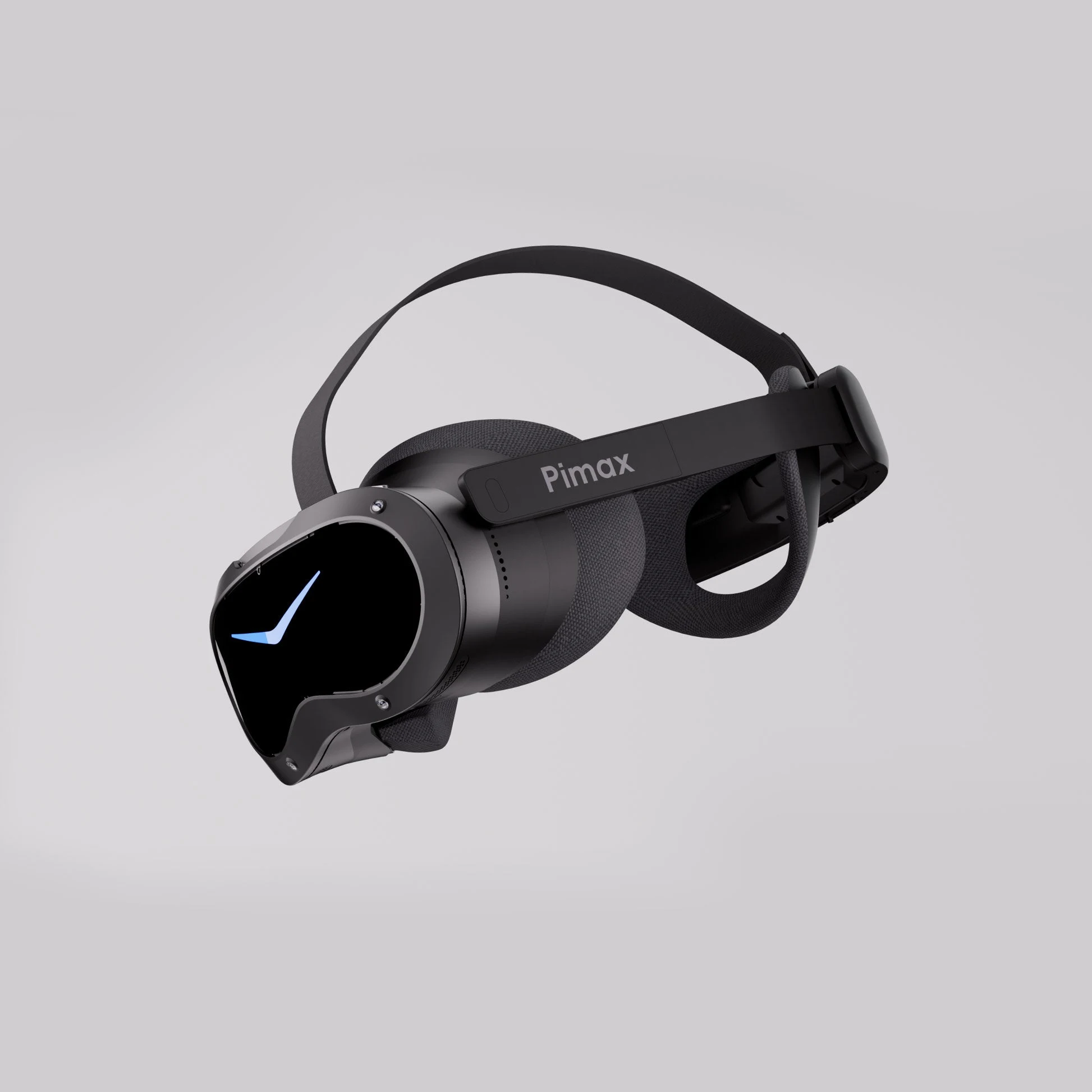 The Crystal Pro features a balanced rear headstrap and modular faceplate design for both wireless and wired racing.
Optics: Pure Glass Clarity vs. Wide Field of View
While both headsets use fast 2880×2880 display panels, their custom lenses create very different driving visuals:
- Somnium VR1: Uses custom double-aspheric lenses engineered to stretch field of view to roughly 125 degrees horizontal. While the wide peripheral view is impressive for spotting cars in your blind spot, the aggressive optical curve creates mild geometric distortion and chromatic aberration near the outer edges of the screen.
- Pimax Crystal Pro: Features custom replaceable aspheric glass lenses calibrated to a 110-degree field of view. By prioritizing optical purity over extreme width, the Crystal Pro achieves a sharp 35 PPD across the entire visual field. Brake distance boards, apex curbing, and digital telemetry stay pin-sharp from center to edge.
Glass lenses also offer superior optical scratch resistance and higher light transmission than plastic aspherics, ensuring vivid contrast during daytime races and clear vision during rainy sessions.
Availability and Production Backlogs
For sim racers looking to upgrade their cockpits this season, availability is a major factor.
Somnium Space manufactures the VR1 by hand in small artisan batches in Prague. Because each unit is custom assembled and individually tested, production capacity is limited. New orders frequently face waiting periods spanning three to five months before dispatch, with premium models running upwards of $3,500.
The Pimax Crystal Pro is produced through mature, scaled manufacturing lines. Pimax has opened pre-order reservations for just $1, giving racers a guaranteed place in line for holiday deliveries alongside exclusive launch bundle pricing.
Head-to-Head Specification Comparison
| Feature | Pimax Crystal Pro | Somnium VR1 |
|---|---|---|
| Resolution Per Eye | 2880 × 2880 QLED | 2880 × 2880 Fast-LCD |
| Lens Construction | Aspheric Glass Lenses (35 PPD) | Double-Aspheric Lenses |
| Field of View | 110° Horizontal | 125° Horizontal |
| Wireless PCVR | 60GHz mmWave 2x2 MIMO | None (Strictly Wired) |
| Wired Connection | DisplayPort 1.4a Dedicated | DisplayPort 1.4 Dedicated |
| Tracking Flexibility | Inside-Out + Modular Lighthouse | SteamVR Lighthouse Built-in |
| Starting Price | $1,399 ($1,899 Bundle) | ~$2,100 – $3,500+ |
Pimax Crystal Pro Reservation
Place a $1 pre-order deposit to lock in early bird production priority and accessory discounts. Use partner code SRN at checkout for extra savings.
SRN
Audio Solutions and Cockpit Ergonomics
Cockpit comfort and acoustic positioning are critical when racing multi-class events in iRacing or ACC.
The Somnium VR1 features a relatively bulky front enclosure that tips the scale at over 700 grams without the cable. Because the center of mass sits forward on your forehead, long racing stints require tightening the rear strap tightly, leading to face pressure. For audio, the VR1 includes standard 3.5mm jacks, requiring you to attach your own headphones or purchase separate audio straps.
The Crystal Pro uses a balanced halo-style rigid strap with a rear counterweight. Its hot-swappable battery sits on a convenient belt clip, removing unnecessary weight from your head. For sound, drivers can mount the newly upgraded DMAS 2.0 off-ear spatial speakers. These off-ear drivers create realistic engine exhaust rumble and 3D positional awareness of passing cars without touching your ears or causing heat buildup during warm sessions.
Black Friday 2026 Speculation
Given Somnium's boutique manufacturing schedule and existing order backlogs, discounts or holiday promotional bundles on the VR1 are virtually impossible for Black Friday 2026.
Pimax, on the other hand, is gearing up for a major holiday campaign. The Pimax Crystal Pro $1 reservation portal allows racers to lock in launch discounts on the headset and the 60G AirLink wireless module. Entering partner coupon code SRN at checkout delivers guaranteed savings on all headsets, replacement glass lenses, and audio accessories.
Frequently Asked Questions
Does the Crystal Pro require base stations like the Somnium VR1?
No. The Crystal Pro includes integrated inside-out tracking cameras so you can use it immediately without base stations. For racers who already own SteamVR 2.0 lighthouses, an optional modular faceplate is available.
Can you replace the lenses on both headsets?
The Crystal Pro features easily removable magnetic glass lenses for cleaning or prescription lens swapping. The Somnium VR1 lenses are fixed inside the optical assembly.
Does the 60GHz wireless link drop if I turn my head quickly?
No. The 60G AirLink uses dual 2x2 MIMO antennas with wide angular coverage, maintaining a reliable direct line of sight within your racing cockpit.
Final Verdict
The Somnium VR1 is a commendable boutique achievement, delivering native SteamVR tracking and an extra-wide 125-degree field of view. However, its high starting price ($2,100+), multi-month backlogs, bulky chassis, and permanent cable tether make it a niche choice for sim racers.
The Pimax Crystal Pro provides a more complete, modern package for sim racers. With uncompressed 60GHz wireless Native Foveated Streaming, distortion-free 35 PPD glass optics, wired DisplayPort endurance capability, and a $1,399 entry price, it delivers top-tier performance with unmatched flexibility.
- Wireless Mobility: 60GHz mmWave uncompressed streaming eliminates cockpit cable tug.
- Optical Purity: 35 PPD aspheric glass lenses prevent peripheral distortion and chromatic aberration.
- Dual Connection Modes: Instant switching between uncompressed wireless and wired DisplayPort tether.
- Faster Delivery: Scaled manufacturing avoids multi-month boutique waiting lists.
- Cost Advantage: Starts at $1,399, saving hundreds of dollars over the base Somnium VR1.