

Samsung is stepping back into the headset market with the Samsung Galaxy XR. Built in close partnership with Google and Qualcomm, the Galaxy XR introduces Google's new Android XR software platform alongside dual 4K micro-OLED panels and Snapdragon XR2+ Gen 2 silicon. Priced near $1,799, it aims to deliver a top-tier mixed reality experience.
For sim racers, hardware specs on paper do not always match what happens on track. Racing in simulators like iRacing, Automobilista 2, or Le Mans Ultimate requires raw graphics throughput, pinpoint optical clarity at extreme distances, and rock-solid tracking stability.
The newly announced Pimax Crystal Pro tackles the cockpit challenge from an entirely different angle. Instead of cramming a mobile computer into the visor, it focuses on high-speed PCVR performance through an uncompressed 60GHz mmWave wireless pipeline and aspheric glass optics. Here is how both headsets match up for serious sim racing.
Video Bandwidth: Uncompressed 60GHz vs. Compressed Wi-Fi 7
The core difference between the two headsets is how they receive visual data from your desktop gaming PC.
The Samsung Galaxy XR is a standalone mobile system. To play PC sim racing titles, you must run wireless streaming software over Wi-Fi 7 or plug in a USB-C data cable. In both cases, your graphics card has to compress the video signal in real time using codecs like AV1 or HEVC. On long track straights, this compression softens distant tarmac textures, blurs 100-meter brake markers, and introduces 25 to 40 milliseconds of latency.
The Pimax Crystal Pro is built from the ground up for PCVR. Its 60G AirLink module uses a dedicated 60GHz millimeter-wave wireless link operating at up to 6 Gbps. Using high-speed eye tracking, it transmits an uncompressed native GPU image directly to where your eyes look. You get true cable-grade clarity wirelessly with under 2 milliseconds of transmission delay.
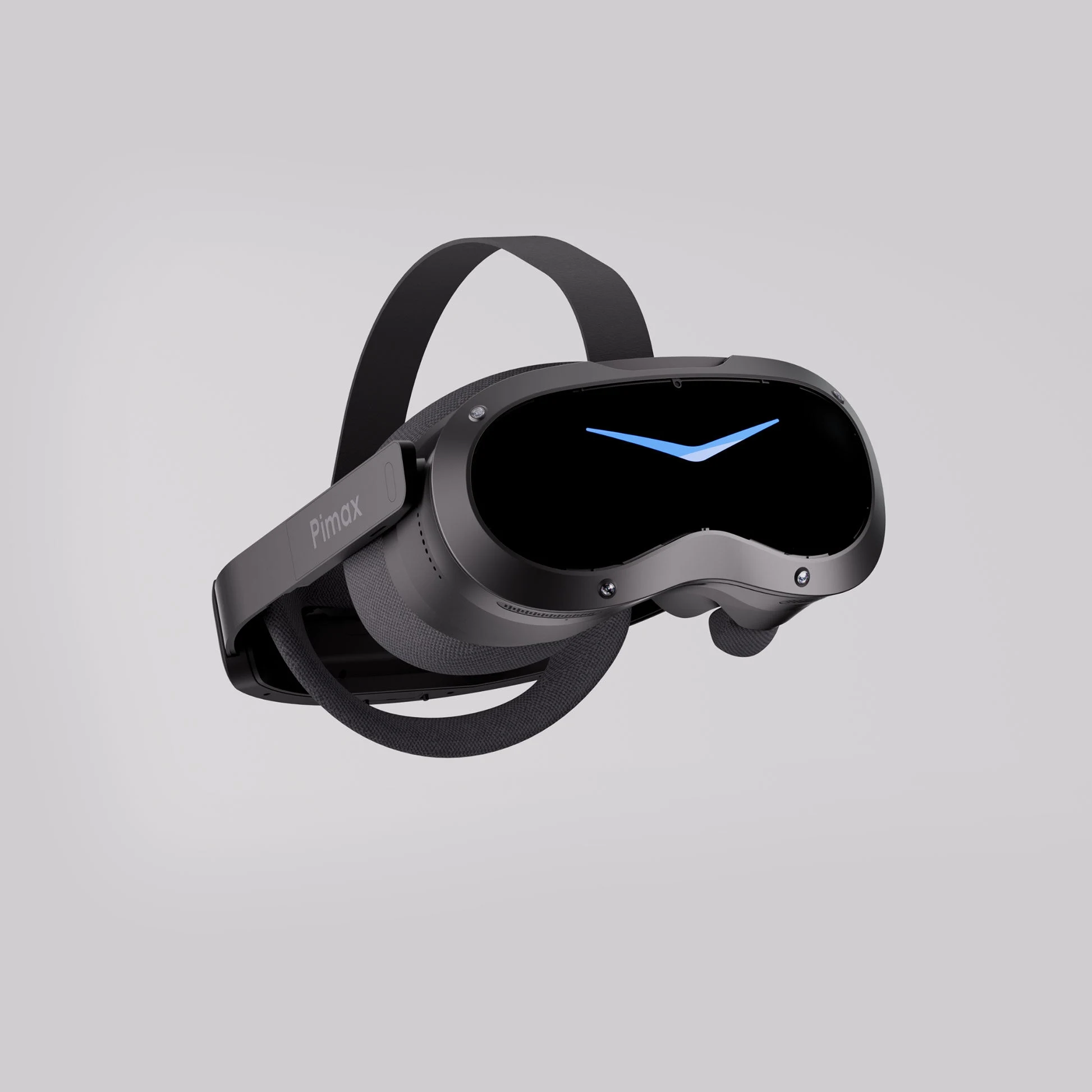 The Crystal Pro combines dual 2880x2880 panels with aspheric glass lenses and direct DisplayPort tethering options.
Optics and Display Performance
Display clarity determines how early you spot your turn-in points and read your digital steering wheel dash.
- Samsung Galaxy XR: Uses dual 3552×3840 micro-OLED displays paired with plastic pancake lenses. While the pixel density is sharp in the center, pancake optics block over 75 percent of display brightness through polarizing filters, resulting in a dimmer image and a narrower horizontal field of view around 95 to 100 degrees.
- Pimax Crystal Pro: Features dual 2880×2880 Quantum-Dot QLED panels with Mini-LED local dimming (576 dimming zones per eye). It uses custom aspheric glass lenses that deliver 35 pixels per degree (PPD) across an expansive 110-degree field of view with maximum light transmission.
In sim racing, optical brightness matters. Glass lenses allow bright sunlight and glowing brake discs to shine without distortion or internal reflections. When driving night stints, the Crystal Pro's local dimming produces deep black levels without washing out nearby cockpit electronics.
Tracking Stability on High-Torque Wheelbases
Direct-drive wheelbases producing 15 to 25 Nm of force feedback send sharp vibrations through your sim chassis. Inside-out optical cameras can struggle with these high-frequency vibrations, causing small tracking skips or view recentering errors while fighting over curbing.
The Samsung Galaxy XR relies solely on inside-out tracking cameras and computer vision algorithms. It has no hardware options for external tracking base stations.
The Pimax Crystal Pro includes an interchangeable faceplate system. Racers can snap on the optional SteamVR Lighthouse faceplate to run SteamVR 2.0 laser base stations. This provides millimeter-level tracking accuracy that remains completely immune to violent cockpit vibrations and rapid head movements.
Technical Specification Breakdown
| Feature | Pimax Crystal Pro | Samsung Galaxy XR |
|---|---|---|
| Display Type | QLED + Mini-LED Local Dimming | Micro-OLED Displays |
| Resolution Per Eye | 2880 × 2880 | 3552 × 3840 |
| Lens Material | Replaceable Aspheric Glass | Plastic Pancake Lenses |
| Field of View | 110° Horizontal | ~95° – 100° Horizontal |
| PC Streaming Protocol | 60GHz mmWave Uncompressed | Wi-Fi 7 Compressed Video Codecs |
| Direct Wired Mode | DisplayPort 1.4a Dedicated Port | None (USB Data Stream only) |
| Base Price | $1,399 ($1,899 Wireless Bundle) | ~$1,799 (Headset Only) |
Pimax Crystal Pro Reservation
Reserve your spot for $1 to lock in early bird production priority and accessory discounts. Enter discount code SRN during checkout for extra savings.
SRN
Battery Life and Endurance Racing
Long endurance races test driver stamina and equipment reliability. A standalone headset running mobile processors and wireless decoding typically lasts 2 to 2.5 hours on battery power before needing a recharge or a tethered battery swap.
The Crystal Pro solves battery limits by offering two operational modes. In wireless mode, its hot-swappable battery sits comfortably at your waist on a belt clip, reducing weight on your face. For 6-hour, 12-hour, or 24-hour endurance events, you simply plug in the direct DisplayPort cable. The headset pulls continuous power and raw video over the tether, eliminating battery anxiety during long night stints.
Black Friday 2026 Speculation
The Samsung Galaxy XR is aimed at general spatial computing, productivity, and casual media streaming. While Google and Samsung plan a wide retail rollout, standalone headsets are rarely discounted during their initial launch window.
In contrast, the Pimax Crystal Pro pre-order campaign is tailored for sim racers looking to upgrade their sim rigs for the holidays. By locking in a $1 reservation now, drivers secure launch window pricing and bundled accessory savings ahead of Black Friday. Adding partner code SRN provides additional checkout savings on all Pimax hardware.
Frequently Asked Questions
Does Samsung Galaxy XR support SteamVR OpenXR directly?
It connects to SteamVR through streaming bridge applications rather than a direct native hardware driver, which can add software overhead and variable frame times in demanding racing titles.
Can I wear glasses inside the Pimax Crystal Pro?
Yes. The Crystal Pro features a roomy facial interface designed to accommodate standard eyeglasses, as well as magnetic prescription lens inserts that click directly over the aspheric glass lenses.
What GPU is recommended to run the Crystal Pro wirelessly?
To power dual 2880x2880 displays at 90Hz or 120Hz, an NVIDIA GeForce RTX 4080, RTX 4090, or newer graphics card is recommended for maximum graphic settings in iRacing and Assetto Corsa Competizione.
Final Verdict
The Samsung Galaxy XR is an impressive mobile device for productivity and Android XR spatial computing, but it lacks the direct video pipe needed for competitive sim racing. Relying on compressed Wi-Fi video streaming compromises visual clarity and adds unnecessary latency.
The Pimax Crystal Pro is purpose-built for PC racers. With uncompressed 60GHz Native Foveated Streaming, a wired DisplayPort endurance mode, 35 PPD glass lenses, and modular Lighthouse tracking support, it offers the uncompromising fidelity and stability sim racers demand.
- Direct GPU Pipeline: 60GHz mmWave streaming bypasses video compression codecs for pure image fidelity.
- No Cable Lag: Under 2ms wireless transmission latency keeps force feedback response instantaneous.
- Optical Transmission: Aspheric glass lenses deliver 35 PPD and superior brightness compared to pancake optics.
- Endurance Ready: Dedicated DisplayPort wired cable mode allows unlimited runtime for 24-hour events.
- Rig Vibration Proof: Optional SteamVR Lighthouse faceplate guarantees tracking stability on high-torque wheelbases.