

When Apple launched the $3,499 Apple Vision Pro, sim racers took immediate notice of one specification: dual 4K Micro-OLED microdisplays boasting incredible pixel density and vivid color saturation. For a moment, cockpit enthusiasts wondered whether Apple's spatial computer could double as the ultimate sim racing display.
The reality of sim racing quickly set in. With no native DisplayPort cable, closed visionOS software, and heavy front-weighted glass, using Apple's headset in a sim cockpit requires a web of workarounds.
Enter the Pimax Crystal Pro. Engineered specifically for high-performance PC simulation, it combines dual 2880×2880 QLED panels with aspheric glass lenses and uncompressed 60GHz mmWave wireless streaming at less than half the Vision Pro's price. Here is how these two optical titans compare on the track.
The PCVR Video Pipeline: Native vs. Compressed Streaming
The fatal flaw of using the Apple Vision Pro for sim racing is video delivery. Apple designed the headset for standalone spatial computing and Mac virtual display extensions. It does not have a native HDMI or DisplayPort input.
To run games like iRacing or Automobilista 2 on the Vision Pro, you have to run third-party software like ALVR to encode your gameplay over Wi-Fi. That encoding introduces two severe penalties:
- Latency Spikes: Video compression and wireless handshakes add 35 to 60 milliseconds of total motion-to-photon delay. When your rear tires lose grip at 120 MPH, that delay means you spin out before your eyes even see the slide start.
- Compression Artifacts: High-speed track motion overwhelms video streaming bitrates, creating blocky macroblocks on distant grandstands and muddying brake marker boards.
The Pimax Crystal Pro approaches PC simulation from an open, native architecture. It supports a direct DisplayPort 1.4a tether for 0ms display lag, or a 60GHz 2x2 MIMO wireless link delivering 6 Gbps uncompressed GPU frames with under 2 milliseconds of latency. You get full native PC rendering exactly as your graphics card draws it.
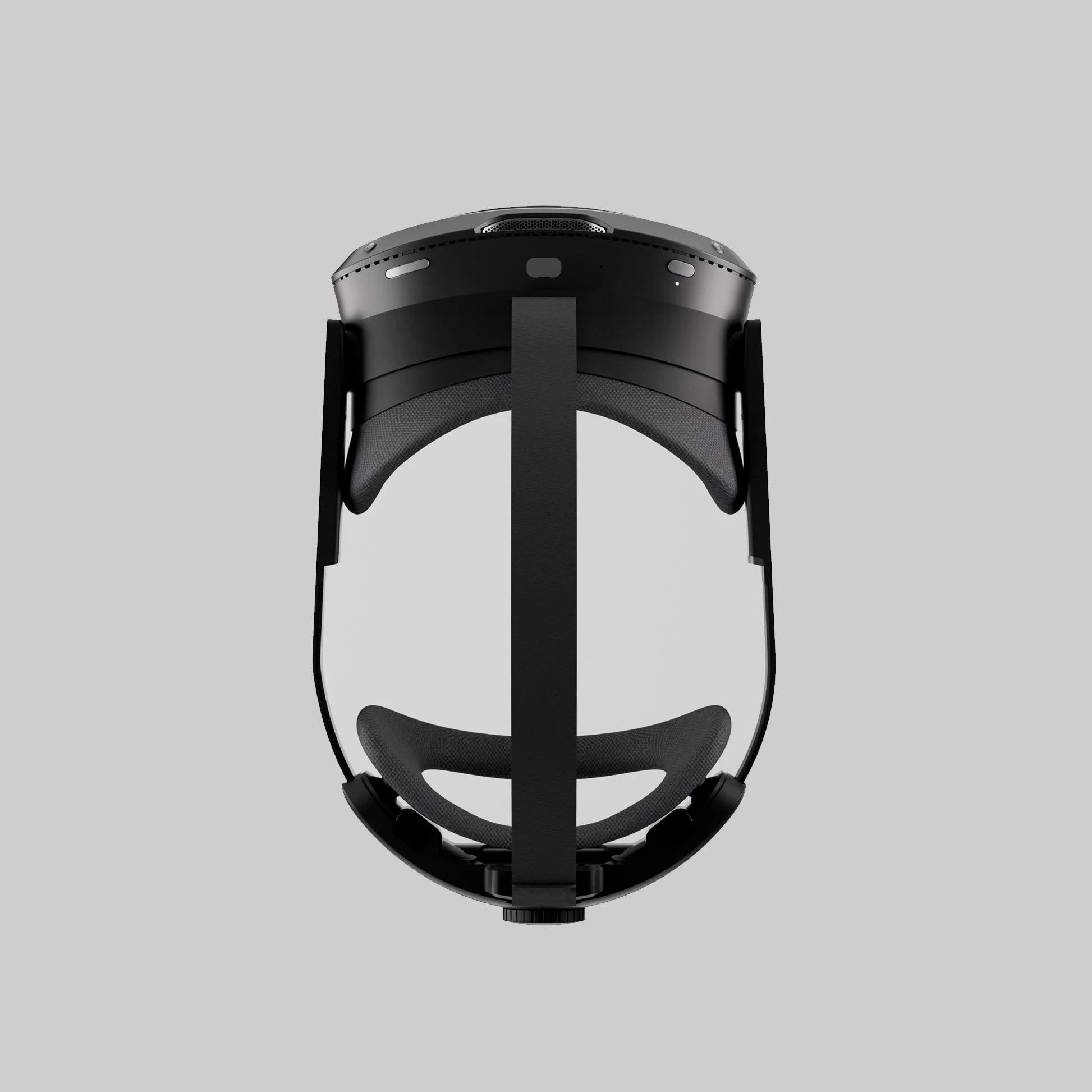 The Crystal Pro features custom-ground aspheric glass lenses that maximize optical sharpness and eliminate chromatic distortion.
Optics and Refresh Rate: 120Hz vs. 90Hz
Apple's Micro-OLED panels offer astonishing color depth and deep contrast, but the Vision Pro is limited to a maximum refresh rate of 90Hz (or 100Hz in special lighting modes).
For sim racing, high refresh rates are essential. Fluid 120Hz rendering provides cleaner motion perception when tracking apex curbs and watching opponents close in your side mirrors. The Crystal Pro natively runs at 72Hz, 90Hz, and 120Hz across both its wired DisplayPort and 60GHz wireless connections.
Furthermore, the Crystal Pro's replaceable aspheric glass lenses deliver 35 pixels per degree (PPD) with a generous 110-degree horizontal field of view. By avoiding the polarizing filters found inside Apple's pancake lenses, the Crystal Pro pumps out 200 nits of bright cockpit illumination without internal lens reflections.
Cockpit Ergonomics and Long-Stint Fatigue
Long driving sessions test headset weight distribution like no other VR genre. In a rigid aluminum sim seat under heavy braking, front-heavy headsets quickly become painful.
The Apple Vision Pro places its curved glass front, aluminum frame, and internal fans directly on your cheekbones and forehead. Weighing over 600 grams on the front of your face without a rigid rear support structure, it leads to red pressure marks and neck strain within 30 minutes of driving.
Pimax designed the Crystal Pro with an external battery system. Power is supplied by a 16,000mAh pack that clips to your belt, keeping the headset chassis light and nimble. A rigid rear headstrap with an adjustment dial distributes clamping pressure evenly around your skull, allowing you to complete multi-hour endurance stints in total comfort.
Quick Spec Comparison
| Feature | Pimax Crystal Pro | Apple Vision Pro |
|---|---|---|
| Base Price | $1,399 | $3,499 |
| Display Panels | 2880 × 2880 QLED Mini-LED | ~3660 × 3200 Micro-OLED |
| Max Refresh Rate | 120Hz native | 90Hz / 100Hz |
| PC Connection | DisplayPort 1.4a & 60GHz mmWave | Compressed Wi-Fi only (ALVR) |
| Motion Tracking | SLAM 2.0 & Modular Lighthouse | Optical Hand & Eye Tracking only |
| Sim Rig Usability | Native Plug & Play | Complex Wi-Fi workaround |
Pimax Crystal Pro Early Reservation
Get dedicated PCVR simulation performance without paying Apple's $3,500 markup. Reserve for $1 and stack code SRN at checkout.
SRN
Black Friday 2026 Speculation
Apple does not participate in Black Friday hardware discounts. The Vision Pro will remain strictly locked at its $3,499 retail price tag with no holiday incentives.
In contrast, Pimax has established a proven track record of holiday discounts and bonus bundles. For Black Friday 2026, sim racers can anticipate bundled accessory perks on Pimax Crystal Pro orders, along with stackable savings using verified partner code SRN. Reserving early ensures you receive priority batch allocation when spring shipments begin.
Frequently Asked Questions
Does Apple Vision Pro support physical motion controllers?
No. Apple Vision Pro relies strictly on optical hand tracking and eye gaze. It does not support standard 6DoF motion controllers or SteamVR tracking accessories.
Why does the Crystal Pro use glass lenses instead of pancake lenses?
Glass aspheric lenses transmit significantly more light than polarizing pancake lenses and eliminate internal reflections, delivering higher brightness and sharper edge clarity in racing cockpits.
Can the Vision Pro run at 120Hz for sim racing?
No. The Apple Vision Pro caps out at 90Hz (or 100Hz in specific modes), whereas the Pimax Crystal Pro provides true 120Hz high-refresh capability for ultra-smooth motion.
Final Verdict
The Apple Vision Pro is a triumph of standalone mobile engineering, but it is not built for the realities of PC sim racing. Its lack of uncompressed display inputs, 90Hz refresh cap, heavy facial weight, and astronomical $3,500 price tag make it a poor fit for dedicated cockpit driving.
The Pimax Crystal Pro delivers exactly what sim racers need: uncompressed 60GHz GPU streaming, a physical DisplayPort tether for 24-hour endurance races, fluid 120Hz rendering, and crystal-clear 2880×2880 glass optics at less than half the cost.
- Direct PC Connection: Zero-latency DisplayPort mode and 60GHz mmWave uncompressed streaming.
- Racing Refresh Rate: Native 120Hz provides fluid motion tracking that 90Hz headsets cannot match.
- Endurance Comfort: External belt battery and rigid headstrap prevent facial pressure points.
- Sim Rig Hardware Support: Swappable Lighthouse faceplate supports laser base stations.
- Unbeatable Value: Full PCVR simulation powerhouse at $1,399 compared to Apple's $3,499 price tag.