
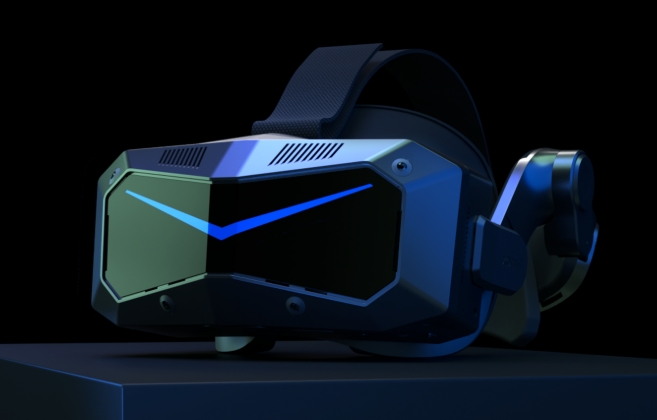
In standard consumer VR, cost reduction is priority number one. To manufacture headsets in the millions, companies use injection-molded acrylic or polycarbonate plastic lenses. While this keeps retail prices low, plastic optics come with fundamental physical limitations that degrade the sim racing experience.
Pimax chose a radically different path for the Crystal series: multi-element precision glass aspheric optics. Understanding why glass changes your performance on the track requires a brief look at the optical physics of human vision in VR.
Eliminating the Dreaded Fresnel "God-Rays"
Traditional Fresnel lenses (found in headsets like the Valve Index and HTC Vive Pro 2) use concentric ridges etched into the plastic to bend light across a shorter focal distance.
When a high-contrast bright object appears on a dark background—such as night racing on iRacing with glowing trackside brake markers, glowing LED steering wheels, or headlights in your mirrors—light scatters off those concentric ridges. This creates blinding white streaks known as god-rays.
Because Pimax glass aspheric lenses have perfectly smooth continuous curvature with zero micro-ridges, god-rays are virtually nonexistent. You experience pure contrast and deep black levels even when surrounded by blinding headlights.
Experience Glass Optics in Person
Order your Pimax Crystal Light or Crystal Super with discount code SRN for 2% OFF at checkout.
Optical Sweet Spot & Eye-Darting
In plastic lenses, chromatic aberration and geometric distortion increase dramatically as your pupil moves away from the dead center of the lens. This narrow zone of clarity is called the sweet spot.
When a headset has a small sweet spot, you cannot simply dart your eyes to read your delta or check your mirrors—you have to turn your entire neck so that the center of the lens points directly at the object.
With Pimax glass aspheric lenses, the sweet spot encompasses virtually the entire field of view. You can check your tire temperatures on your dashboard LCD or spot a competitor alongside you by glancing with your eyes naturally, just as a real driver does in a GT3 or Formula cockpit.
Scratch Resistance & Long-Term Rig Durability
Plastic lenses are exceptionally soft. Even gentle cleaning with an ordinary microfiber cloth can leave permanent micro-scratches that cause persistent blurriness over time. Furthermore, if you wear eyeglasses inside your headset, accidental contact will instantly ruin plastic lenses.
Optical glass is exponentially harder on the Mohs mineral hardness scale. Pimax glass lenses feature professional anti-reflective and scratch-resistant coatings similar to high-end DSLR camera lenses, ensuring pristine optical clarity for years of endurance racing.