
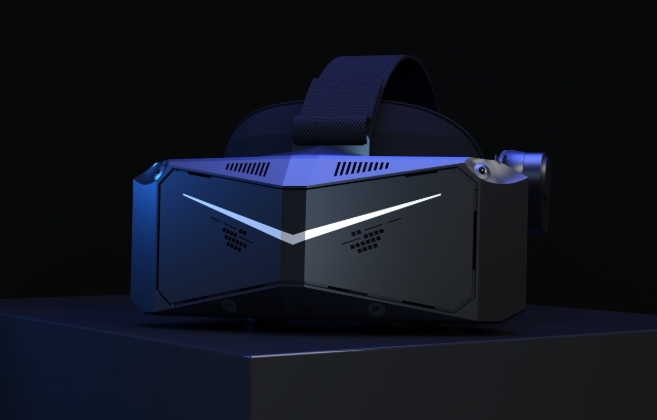
Sim racing in virtual reality has reached an inflection point in 2026. For years, sim racers were forced to compromise: either accept the compressed video encoding and latency of standalone headsets like the Meta Quest 3, or spend thousands on cumbersome base-station setups.
The Pimax Crystal Light fundamentally changed this calculus. By stripping out the battery and standalone processor of the original Crystal while preserving its legendary 2880 × 2880 per-eye glass aspheric optics, Pimax built what has become the consensus choice among competitive iRacers and endurance sim drivers.
Why Sim Racers Cannot Tolerate Video Compression
When driving at 200 mph into Turn 1 at Monza or the Nürburgring Nordschleife, every millimeter of track awareness counts. Most casual VR headsets (such as the Quest 3) connect to your gaming PC over USB-C or Wi-Fi 6E. This requires your GPU's video encoder to compress the image into H.264 or AV1, send it across the cable, and have the headset chip decompress it.
This encoding pipeline introduces two catastrophic issues for racing simulators:
- Added Latency: 25ms to 45ms of motion-to-photon latency dampens your reaction time when catching snap oversteer.
- Compression Artifacts in Distance: Complex tarmac textures, distance brake boards, and grass run-off areas turn into a blurry, pixelated smear down the straightaway.
The Pimax Crystal Light eliminates this completely with a direct DisplayPort 1.4 connection. You receive the raw, uncompressed 8.3-megapixel video stream straight from your graphics card frame buffer, with sub-millisecond transmission latency.
Save 2% OFF Crystal Light
Use exclusive partner coupon code SRN during checkout on the official Pimax store.
The Glass Optics Advantage: Spotting the Apex
Resolution is only half of the optical equation. The other half is the lenses. The majority of VR headsets use molded plastic pancake or Fresnel lenses. While pancake lenses are compact, plastic optics suffer from internal reflections, lower light transmission, and significant chromatic aberration around the perimeter.
The Crystal Light utilizes coated glass aspheric lenses. Glass provides vastly superior light transmission, near-zero distortion, and a massive optical sweet spot. In practical sim racing terms:
- You can glance at your virtual side mirrors with your pupils rather than rotating your entire head.
- Digital steering wheel dashes (MoTeC, Bosch DDU) are crystal clear and readable down to the decimal point without zooming in.
- Night racing with headlights behind you produces crisp illumination without the blinding halos and "god-rays" typical of Fresnel designs.
GPU Requirements: Can Your Rig Run It?
At 2880 × 2880 per eye running at 90Hz or 120Hz, the Crystal Light demands serious graphics horsepower. However, thanks to native OpenXR and Fixed Foveated Rendering (FFR) built directly into the Pimax Play software, you do not need an extreme dual-GPU setup.
- NVIDIA RTX 4070 / 3080 Ti: Excellent performance in iRacing and Automobilista 2 at 90Hz with medium-to-high settings and FFR enabled.
- NVIDIA RTX 4080 / 4090: The ultimate experience. Maxed-out grid sizes, rain effects in ACC and Le Mans Ultimate, and solid 120Hz locked frame rates.
Final Verdict
At a starting price of $899 USD, the Pimax Crystal Light occupies a sweet spot that no competitor can match. It offers significantly higher resolution and optical clarity than the Quest 3, avoids the base-station complexity and custom face-gasket hassles of the Bigscreen Beyond, and delivers genuine enthusiast-grade sim racing immersion.